
Free sugars allude to monosaccharides, (for example, glucose, fructose) and disaccharides, (for example, sucrose or table sugar) added to foods and drinks by the maker, cook or shopper, and sugars commonly introduce in nectar, syrups, organic product squeezes and organic product juice condensed.
"We have robust proof that keeping intake of free sugars to less than 10% of total energy intake reduces the danger of overweight, obesity and tooth rot," says Dr Francesco Branca, Director of WHO's Department of Nutrition for Health and Development. "Rolling out strategy improvements to help this will be key if countries are to experience their responsibilities to reduce the trouble of noncommunicable diseases."
The WHO guideline does not allude to the sugars in new foods grown from the ground, and sugars characteristically display in milk, on the grounds that there is no reported proof of unfriendly effects of devouring these sugars.
A significant part of the sugars devoured today are "covered up" in prepared foods that are not generally seen as desserts. For instance, 1 tablespoon of ketchup contains around 4 grams (around 1 teaspoon) of free sugars. A solitary container of sugar-sweetened pop contains up to 40 grams (around 10 teaspoons) of free sugars.
Overall intake of free sugars changes by age, setting and nation. In Europe, intake in adults ranges from around 7-8% of total energy intake in countries like Hungary and Norway, to 16-17% in countries like Spain and the United Kingdom. Intake is much higher among children, running from around 12% in countries like Denmark, Slovenia and Sweden, to about 25% in Portugal. There are likewise country/urban contrasts. In rustic groups in South Africa intake is 7.5%, while in the urban population it is 10.3%.
Decreasing sugars intake to less than 10% of total energy: an in number recommendation
The recommendations are in light of analysis of the most recent scientific proof. This confirmation shows, in the first place, that adults who expend less sugars have lower body weight and, second, that expanding the measure of sugars in the eating routine is connected with a weight increment. Furthermore, research demonstrates that children with the most noteworthy intakes of sugar-sweetened drinks are more prone to be overweight or hefty than children with a low intake of sugar-sweetened drinks.
Further reduction to less than 5% of total energy intake: a contingent recommendation
Given the nature of existing studies, the recommendation of decreasing intake of free sugars to beneath 5% of total energy is introduced as "restrictive" in the WHO framework for issuing confirmation based direction.
Few epidemiological studies have been attempted in populations with a low sugars intake. Just three national far reaching studies permit a correlation of dental caries with sugars intakes of less than 5% of total energy intake versus more than 5% yet less than 10% of total energy intake.
Source: WHO Media Center
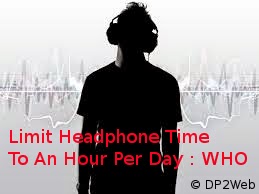
A few studies have demonstrated that the quantity of young people with harmed hearing has expanded over the previous decade, likely on account of the uplifted utilization of iPods and cell phones to play loud music. In 1994, 3.5 percent of American teens experienced listening to misfortune, however that number rose to 5 percent by 2006. To battle this expand, the WHO prescribes listening to mobile gadgets for a most extreme of one hour per day, and the volume ought to stay around 60 percent.
The thought is to minimize perilous listening practices, which rely on upon two factors: to what extent you listen and how loud the sound is. The sound of a regular discussion is 60 decibels, which won't result in any listening to issues. In any case a sitting out of gear bulldozer is around 85 decibels, which can result in permanent harm after eight hours. Sounds like an applaud of thunder or even a nearby vuvuzela time in at 120 decibels, harming hearing after only nine seconds. Listening to misfortune from these loud, managed sounds can be prompt, or they develop after some time as the fragile structures in the internal ear get to be more harmed.
Be that as it may, headphones can be both great and terrible for our sound-related health, as per Kathleen Campbell, an educator at Southern Illinois University School of Medicine who spends significant time in audiology. Over-ear or clamor scratching off headphones are perfect, in light of the fact that they urge people to turn down the volume of the music they're playing. People have a tendency to incline toward their music to be relatively louder than any foundation commotion, however in the event that they can't hear that clamor, they're not as slanted to turn up the music's volume. Defective headphones, then again, make us more prone to turn up the volume, which can be awful news; headphones at greatest volume can debilitate hearing in only four minutes, and numerous young people don't even understand that those stunning impacts can be permanent.
To prevent listening to misfortune considerably further, WHO takes note of that headphone producers and government regulators ought to do their part to create listening gadgets that don't unavoidably affect listeners. Loud venues like shows or clubs ought to offer earplugs or calm spaces where benefactors can show their ears an a bit of mercy.
However meanwhile, WHO says its dependent upon listeners to deal with their listening ability. The sort of music you listen to isn't as imperative as its volume or span, Campbell says, "yet devotees of distinctive sorts of music have a tendency to have diverse volume inclination." Using commotion dropping headphones may help listeners oppose the allurement to turn it up.
